
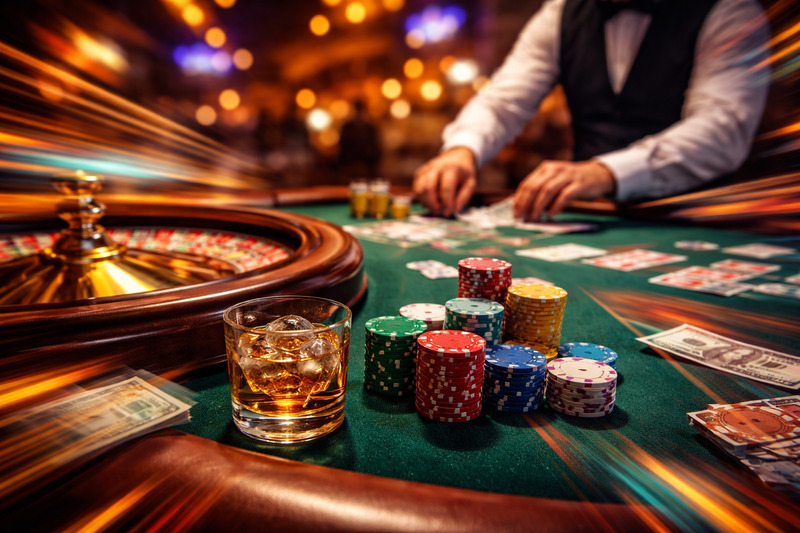
The house edge is one of those concepts that feels settled, agreed upon, filed away somewhere in the brain under “things that are true but not urgent.” It gets mentioned early, often with a shrug, as if acknowledging it once is enough to neutralize it. Two percent. One percent. A number small enough to feel negotiable, especially when everything else about the game feels exciting, noisy, alive.
What usually gets lost in that early explanation is that the house edge is not a single event. It is not a one-time fee. It is a pressure applied repeatedly, quietly, every single time a bet is placed, which means the real question is not how big the edge is, but how often it gets invited to the table.
That’s where time enters, unannounced, pretending to be harmless.
Speed Isn’t Loud, Which Is Why It Works
Table speed doesn’t announce itself. There’s no warning light that flashes when things start moving faster than they used to. It just feels smoother. Cleaner. More efficient.
A faster dealer feels professional.
A quicker spin feels modern.
An instant re-bet button feels convenient.
None of this feels dangerous, and that’s kind of the point. Speed removes the empty spaces, the little gaps where people used to lean back, look at their chips, reconsider, or simply notice how long they had been sitting there. When those gaps disappear, decisions start stacking up, not because anyone is being reckless, but because continuing feels easier than stopping.
Momentum is comfortable. Reflection is not.
Roulette and the Strange Disappearing Hour
Roulette is often treated like an honest game, not because it’s generous, but because it doesn’t pretend to be anything else. The odds are known. The disadvantage is fixed. Everyone agrees on the math.
And yet, roulette might be one of the clearest examples of how table speed changes everything without changing anything at all. A traditional wheel, with physical chips and human pauses, naturally limits how many spins fit into an hour. There’s talking. There’s waiting. There’s dead time.
Online, that dead time vanishes. Spins arrive one after another with almost no interruption, and before it’s noticed, an hour has quietly turned into a long list of outcomes that all looked small on their own. The wheel didn’t cheat. The odds didn’t shift. The only thing that changed was how quickly probability was allowed to repeat itself.
Losses don’t feel heavier. They just arrive more efficiently.
Blackjack, Fatigue, and the Slow Leak of Precision
Blackjack has a reputation for being beatable, or at least negotiable, and that reputation comes from the fact that decisions matter. Strategy charts exist for a reason. Discipline is rewarded, at least in theory.
In practice, speed complicates things. Faster tables demand quicker decisions, and quicker decisions gradually slide away from careful calculation toward instinct, especially as sessions stretch on and mental sharpness starts thinning out. No dramatic mistake is required. No wild deviation. Just a few rushed choices here and there, decisions made because the next hand arrived before the previous one fully registered.
The house doesn’t need players to play badly. It only needs them to stop playing perfectly, and speed makes perfection exhausting.
A Small Detour Into Modern Platforms
This shift toward speed isn’t accidental, and it’s especially visible on modern platforms built around seamless play. Take 22Bet, for instance. The platform offers a broad range of fast-moving tables and live dealer formats designed to keep things flowing, particularly for players looking for casino games real money without friction or downtime. Everything feels immediate, which is appealing, but that immediacy also allows the house edge to express itself more quickly, simply because the game never really pauses long enough to reset perspective.
Nothing is hidden. Nothing is unfair. The environment just does a lot of the work on its own.
Why Fast Play Rarely Feels Risky
One of the more curious things about speed is that it often feels safer than slower play. Fast games feel controlled, professional, even efficient, while slow games can feel clumsy or outdated. Humans tend to trust smooth systems, especially when those systems don’t interrupt themselves.
There are no pauses which eliminate the time when doubt tends to creep into it. It is only in the absence of such pauses that betting becomes the default, and quitting starts to be a disruption and not a choice anymore. It is not manipulation as we understand it in drama; it is design and design to human behavior, and that design is very strong.
Time, Variable Nobody Talks Of
House edge is printed. Time is not. But time is the factor that dictates that a disadvantage remains merely the word of mouth, or becomes very personally true. Even a few bets are hardly interesting. A losing streak is something that can be bearable even when it is a gradual one. However, accelerate the process and squeeze the experience and the math will reel in ahead of the emotions.
Casinos do not require larger bets. They don’t need louder tables. They only require more than one decision per hour, as probability only works best when it has time and repetition.
It is Not the Right Thing to Slack With Slowing Down and That is the Point
Purposefully slackening pace contradicts the trend of the contemporary gambling design. Playing at a slower pace, not using turbo, and between breaks which do not seem to be necessary, or playing fewer hands per session all feel a bit clumsy, almost inefficient.
It is that uneasiness that makes it effective. The slowing down does not alter the odds but simply reduces the number of opportunities that the odds have to operate. It establishes the space in which awareness can resume, albeit temporarily and in some cases just that space will suffice to prevent a session running away silently.
The Ending That Never Needs Announcing
Casinos don’t need to explain table speed, because table speed doesn’t need defending. The rules remain fair. The math remains consistent. Everything works exactly as advertised.
The only thing that changes is how quickly the clock is allowed to do its job.
And the clock, unlike players, never gets tired, never hesitates, and never forgets why it’s there.