
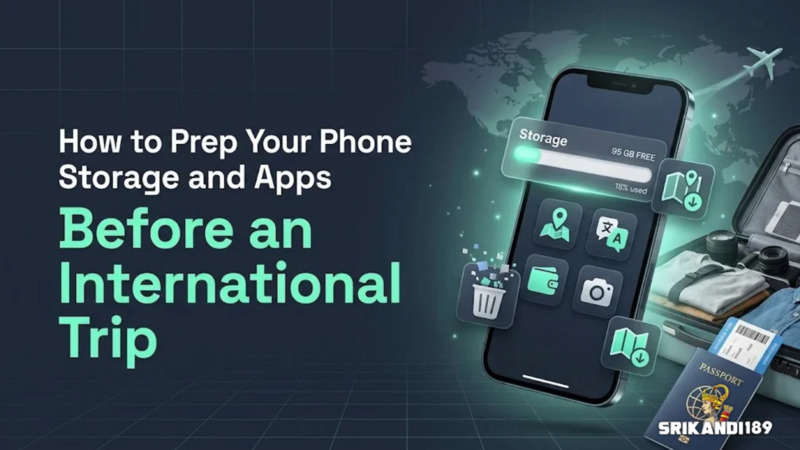
Most trips to the airport find the person already having a suitcase packed and ready to go, but most travellers do not spend a minute planning what is in the suitcase’s digital space – their smartphones.
It is a fault that nearly always assails you at the most inopportune moments. Not much is worse than a full storage warning popping up as you’re about to take a video, or an important transit application not loading while you’re travelling on a slow foreign network.
You need to use your phone for a lot of things while you’re overseas, such as your camera, your translator, your wallet for tickets, and your portable entertainment center when you’re looking to relax in a hotel room during a break and want to log in to srikandi189 and chill. It takes an hour to clear digital clutter and set the apps before heading out, for a fast and stable performance from takeoff to touchdown.
Clearing Out Hidden Storage Hogs Before You Pack
Modern smartphone cameras take amazing video and high-resolution burst photos, and can rapidly fill up several gigabytes of storage in an afternoon of sightseeing. More significantly, at least one-fifth of the mobile operating system’s inbuilt flash memory should be available for use as virtual memory “swap space” or it will get sluggish and apps will take double the time to load.
Offload Old Media and Clear the Recently Deleted Folder
While going through your camera roll to axe the blurry screenshots is a good first step, the real space suckers are old, multi-minute videos and bursts of photos. Take advantage of your high-speed home Wi-Fi to upload your old videos to a home laptop or back up your library in the cloud if you have an account that is capable of that. After deleting these hefty files from your device, be sure to check the “Recently Deleted” or “Trash” folder in your gallery and delete the files manually. Otherwise, the deleted gigabytes will remain on your phone for another 30 days, and no gigabytes will be freed up for your trip.
Purge Bloated App Caches and Old Downloads
Social media apps, music streamers and web browsers stealthily store gigabytes of temporary cache files, such as video clips you’ve watched, high-resolution thumbnails or old podcasts you’ve listened to from months ago. Check out your phone’s storage settings and determine which apps have grown much larger than the size at installation. To free up 10 to 20 GB of new storage space easily, without losing any personal data, clear the cache in your browser and messaging apps, and delete old PDF attachments or streaming downloads.
Updating and Testing Essential Travel Apps at Home
It’s a headache you could avoid, when you discover a key application is stuck on a big software update, or a confirmation text message is needed at your home phone number, and you’re standing on the platform of a foreign train station.
Run All App and System Updates on Home Wi-Fi
48 hours before your flight check your app store and manually update all of the apps you have installed and then apply any patches to your operating system. For security concerns, many airlines, ride-share and online entertainment companies do not allow older versions of their apps to access their servers. Keeping everything up-to-date on your fast home WiFi saves you from using up a huge amount of international roaming data or waiting an hour to update on a crowded airport WiFi connection.
Log Into Your Accounts and Test Offline Modes
Don’t wait till you’re in a new country to use a ride-hailing, airline or translation app for the first time. Two-factor authentication, credit card verification, or email confirmation is almost always required during a first-time login – and these are tedious to do, especially while you’re traveling. Open each travel, banking and entertainment app at home and log in and ensure that your biometric login or password manager has your details programmed correctly.
Downloading Offline Lifelines Into Your Fresh Space
After you’ve purged gigabytes of dated junk, you can store a small amount of offline content that will keep you cruising during those moments when cell coverage is lost.
Save Regional Maps and Language Packs Locally
A crowded city with live cellular data is a killer for the battery and doesn’t perform well in tight streets or underground stations in a strange city. Use your mapping software of choice and download the whole of the metropolitan area of your destination directly to your internal storage. Go to the same process within your translation application and download the local language pack for offline text/camera translation. With both stored locally, you can read street signs, menus and walking directions in real time even when you’re in Airplane Mode.
Store Boarding Passes and Backup Documents Locally
Avoid having to look for your flight barcode or hotel address from your email inbox while using spotty airport Wi-Fi, while waiting at a customs desk. Place any boarding passes, train tickets or other reservation confirmations in your phone’s digital wallet, and store PDF copies or screen shots in a “Travel” album in your offline files app for quick and easy access.
Taming Background App Behavior for the Road
Lastly, you need to instruct your apps on what to do when they’re not in front of you. Turn off auto updates of the app store using cellular data; program the cloud photo library to pause backups when not connected to WiFi at night or plugged into a charger. Your smartphone will remain sleek, spacious and ready for anything you may encounter abroad by discarding some of the digital flotsam and jamming and setting up your software before you pack up your carry-on.