
The Mathematics of Jackpot Bonuses, Bankroll Unit Staking, and High-RTP Instant Games in Kenya
Every weekend across Kenya and East Africa, hundreds of thousands of football fans study team sheets for 13-match midweek jackpots and 17-match mega jackpots. The allure of turning a KSh 50 or KSh 99 ticket into tens of millions of shillings is undeniable. However, the vast majority of casual punters treat jackpot slips and weekend accumulators as an all-or-nothing lottery—ignoring the consolation tier math, staking far too much of their M-Pesa balance on a single afternoon, and bleeding capital on high-friction platforms.
When you examine how disciplined East African bettors survive variance and stay profitable across an entire football season, three habits stand out: understanding how partial jackpot bonus pools split, enforcing strict 1%–2% unit sizing on regular slips, and choosing automated M-Pesa rails with transparent Return-to-Player (RTP) mechanics for instant games.
Let’s break down the exact numbers behind each pillar.
1. How 15/17 and 16/17 Jackpot Bonus Pools Actually Pay Out
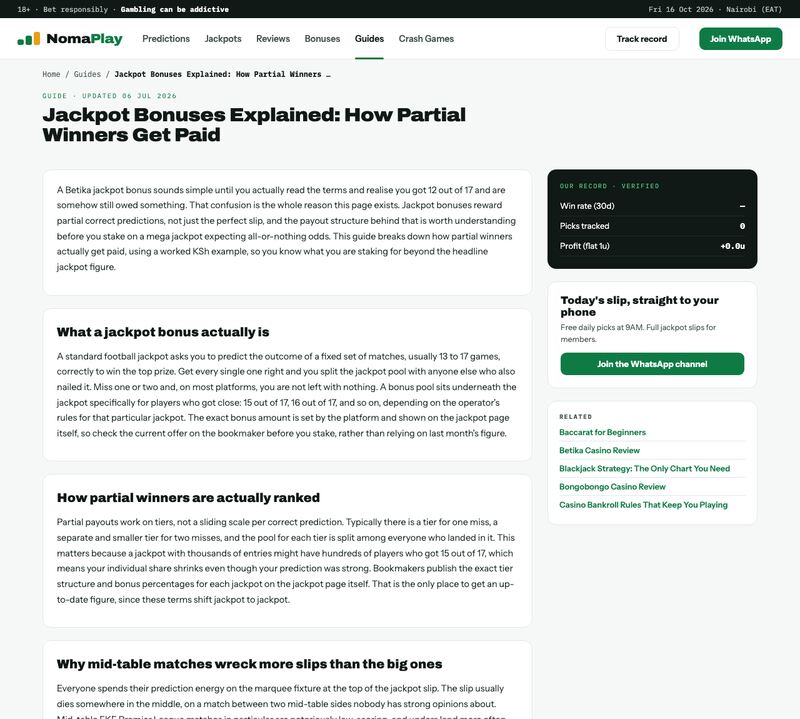
Predicting 17 straight 1X2 outcomes correctly carries raw mathematical odds of 1 in 129,140,163. Because hitting every single fixture is so rare, the real strategic battleground on Kenyan weekend and midweek jackpots lies in the consolation bonus tiers—typically awarded for 12/13, or 14/17, 15/17, and 16/17 correct predictions.
Two mistakes routinely wreck promising jackpot tickets before kickoff:
- Over-Focusing on Marquee Fixtures: Everyone spends twenty minutes analysing Arsenal vs. Liverpool at the top of the card, only to guess blindly on a low-scoring mid-table clash in the middle of the slip—where draws and Under 2.5 results land far more frequently than public sentiment expects.
- Misunderstanding Pool Dilution: Jackpot consolation payouts are not fixed cash prizes; they are pari-mutuel tier pools divided equally among everyone who lands in that exact bracket that week.
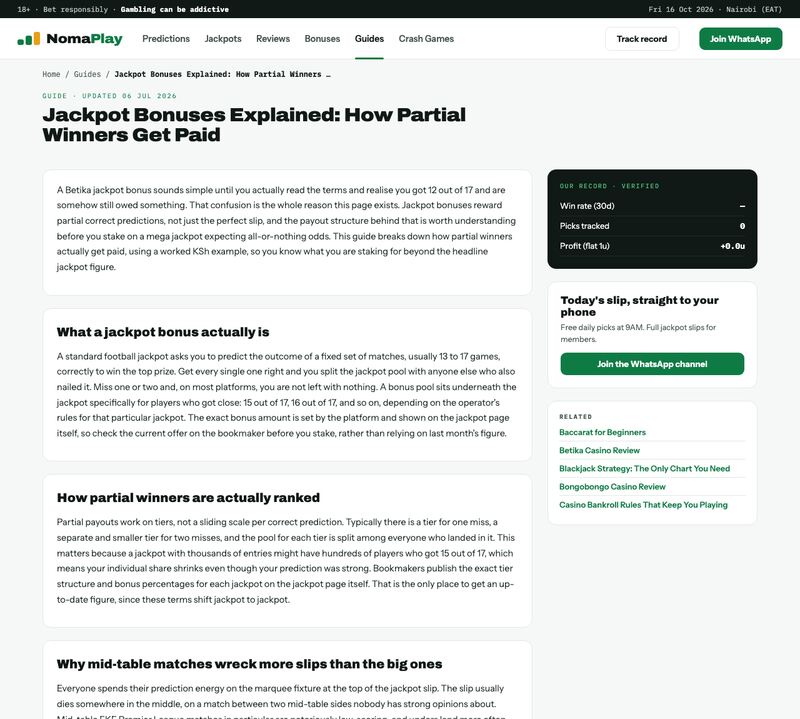
If 800 punters all ride heavy home favourites and land on 15 out of 17 correct picks in the same weekend, the 15/17 bonus pot is split 800 ways, resulting in a modest payout per ticket. Conversely, when you identify two contrarian draws in tight mid-table fixtures, you separate your slip from the crowd and capture a much larger share of the tier pool. Before funding multi-line combinations or double-chance permutations, reviewing a clear guide on how jackpot bonuses work for partial winners ensures you know exactly how tier sharing, claim rules, and combination costs affect your real return.
2. Eliminating the “Wipeout Saturday” With a Bankroll Unit Calculator
Even the sharpest football analyst in Nairobi will experience a four- or five-match losing streak during a volatile Premier League or Champions League week. The difference between an analyst who bounces back on Sunday and a casual punter who has to reload via M-Pesa is unit sizing.
Most bankroll blowouts happen because bettors adjust their stake based on emotion: staking KSh 500 on an early kickoff, losing to a 94th-minute equalizer, and immediately staking KSh 1,500 on the evening match to “win it back.”
To remove emotion from your staking, professional bettors divide their total ring-fenced sports balance into fixed percentage units:
- Conservative Model (1% per unit on KSh 5,000): KSh 50 standard stake (1u) | KSh 150 max stake (3u) | 100 units cushion
- Moderate Model (2% per unit on KSh 5,000): KSh 100 standard stake (1u) | KSh 300 max stake (3u) | 50 units cushion
- Aggressive Model (5% per unit on KSh 5,000): KSh 250 standard stake (1u) | KSh 750 max stake (3u) | 20 units cushion
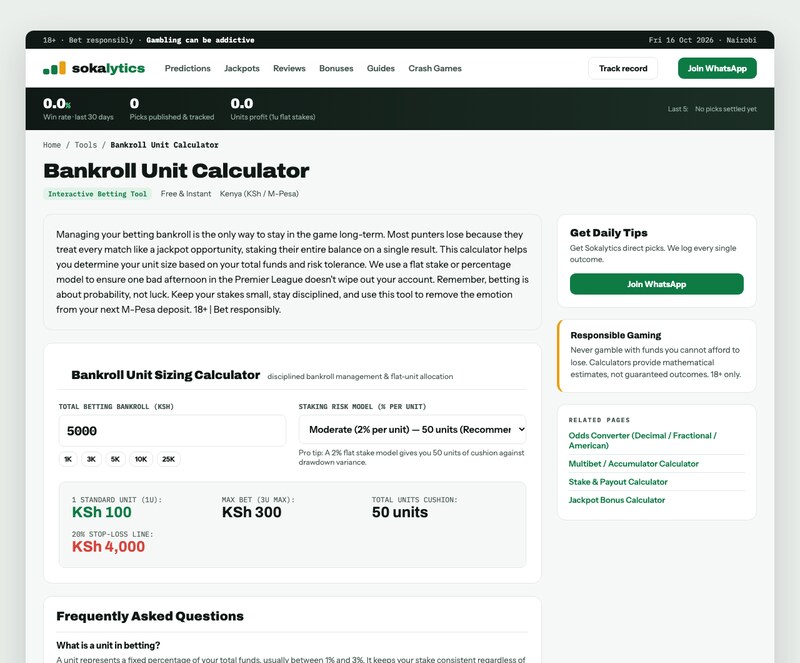
As shown in the worked model above, if your total weekend bankroll is KSh 5,000, a 2% flat-unit structure sets your standard single-match stake (1u) at KSh 100, caps your highest-conviction play (3u) at KSh 300, and establishes a hard 20% stop-loss line at KSh 4,000. Plugging your starting balance into an interactive bankroll unit calculator before Saturday’s early kickoff gives you a 50-unit cushion against normal football variance—making it virtually impossible for one bad afternoon to wipe out your account.
3. Why Payment Automation and High RTP Matter for Instant Games
Many Kenyan football bettors set aside a small fraction of their weekly entertainment budget—such as half a unit (0.5u)—for fast-paced crash multipliers (Aviator, Paka Kumi) or high-RTP 3D slots (Double Ruby, Aztec Gems, 5 Lions) while waiting for match results.
When choosing where to play instant games, two technical details separate modern Kenyan platforms from legacy operators:
- Micro-Stakes and High Return-to-Player (RTP): Look for platforms that allow micro-stakes starting from KSh 10 so your session fits comfortably inside a small unit budget, paired with transparent RTP percentages between 96.5% and 97%.
- Zero-Fee Daraja STK Push & Automated B2C Cashouts: Legacy platforms often require copying Paybill numbers manually and waiting hours for manual compliance approval when you cash out a win. Modern cashiers trigger an instant USSD PIN prompt on your handset and dispatch winnings back to Safaricom M-Pesa in seconds via automated Business-to-Customer (B2C) webhooks.
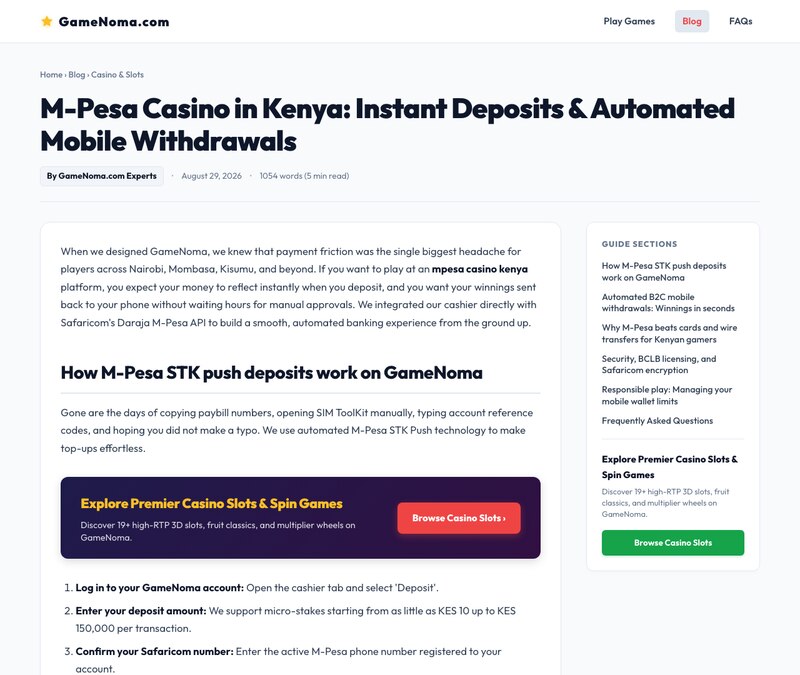
Understanding how instant M-Pesa casino deposits and automated B2C withdrawals work ensures that when you hit a clean multiplier on Aviator or a bonus round on Double Ruby, your payout lands directly on your phone with zero withdrawal delays—preventing the classic trap of reversing a pending cashout out of impatience.
Summary: Building a Smarter Weekly Routine
You do not need to predict every shock upset in the Premier League to come out ahead over a season. By treating jackpot slips with realistic bonus-tier math, locking your regular match stakes to a strict 2% unit size with a 20% stop-loss floor, and insisting on instant, zero-friction M-Pesa payouts across both sports and high-RTP instant games, you put structure and discipline firmly on your side.