
A big Premier League match is approaching. Your favourite team has won four games in a row, the odds look attractive, and everyone seems confident about the result. But there’s one problem: their main striker might not play.
This is exactly why a sensible football betting strategy starts with understanding the match rather than simply following popular predictions. If you’re unfamiliar with statistics such as expected goals (xG), shots on target or clean sheets, the football guides at MatchXI provide helpful explanations before you begin analysing a fixture.
The good news? You don’t need to be a professional analyst to ask better questions about football matches. You just need a repeatable process.
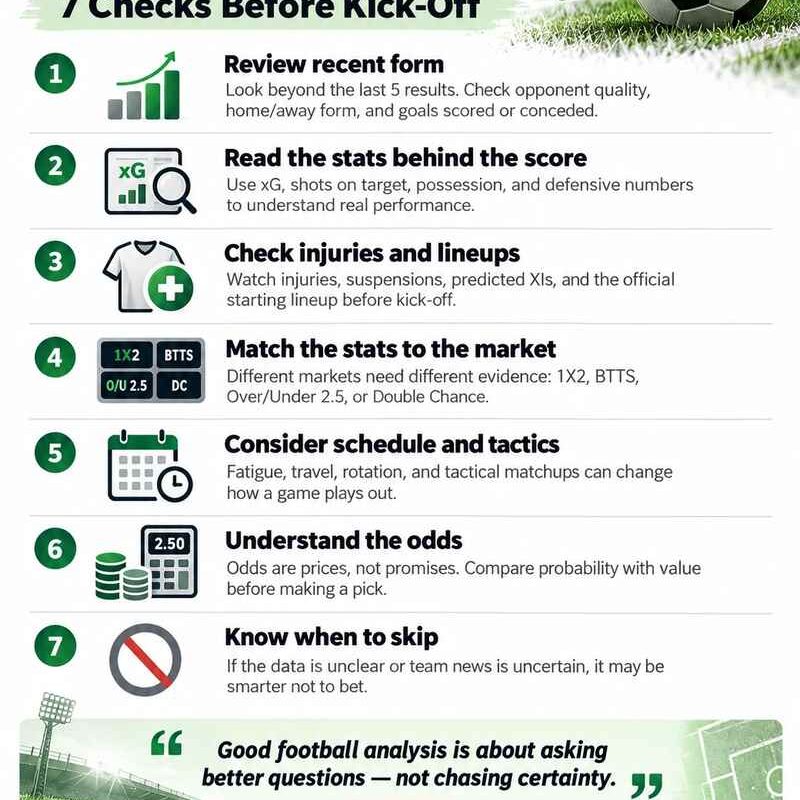
Here are seven checks worth making before kick-off.
1. Look Beyond the Last Five Results
Imagine two teams preparing for a weekend clash.
Team A has won four of its previous five matches. Team B has won only twice.
At first glance, Team A looks like the obvious favourite. But football form rarely tells the whole story.
What if Team A’s victories came against struggling opponents? What if Team B recently faced three of the strongest clubs in the league?
Instead of relying exclusively on wins and losses, consider:
- Strength of opposition: Were recent results achieved against strong or weak teams?
- Home and away performance: Does the team perform significantly better at its own stadium?
- Goals scored and conceded: Are results supported by consistent attacking and defensive performances?
- Match circumstances: Did a red card, penalty or unusually early goal change the previous game?
Five results offer context, not a guarantee of what happens next.
2. Understand the Statistics Behind the Scoreline
A 2-0 victory can describe two very different performances.
One team might dominate possession, create several dangerous chances and comfortably control the game. Another might score from its only two meaningful attacks while spending most of the match defending.
Both teams win 2-0, but the underlying performances are different.
This is where football statistics become useful.
| Statistic | What it helps you understand | Important limitation |
|---|---|---|
| Expected goals (xG) | Quality of scoring chances created | Does not guarantee actual goals |
| Shots on target | Attempts that required a save or resulted in a goal | Not every shot has equal difficulty |
| Goals conceded | Recent defensive outcomes | Can be affected by penalties and unusual events |
| Home/away form | Performance in different playing environments | Small samples can be misleading |
| Possession | How much a team controlled the ball | More possession doesn’t always mean better chances |
| Head-to-head results | Historical meetings between opponents | Old matches may involve different players and coaches |
For example, if a team regularly creates high-quality chances but has recently struggled to finish them, its results alone may understate its attacking performances.
The opposite is also possible: a team scoring from nearly every opportunity may not maintain that finishing rate indefinitely.
Statistics help you investigate these patterns. They cannot remove the unpredictability of football.
3. Check Injuries, Suspensions and Starting Lineups
Here’s a familiar scenario.
You research a match on Friday evening. Everything points towards a strong performance from the home side.
By Saturday afternoon, however, the manager has confirmed that two important players are unavailable.
Your original analysis may no longer apply.
Team news deserves special attention because football depends on combinations, not just individual talent.
Consider these three stages of information:
Early team news: A player may be injured, suspended, returning to training or undergoing a fitness assessment.
Predicted starting XI: Journalists and statistical models estimate who might start. These predictions can change and should never be treated as official confirmation.
Official starting XI: The confirmed team sheet identifies the selected starters and substitutes for that fixture.
A missing striker might reduce a team’s attacking options. An absent defensive midfielder could affect how easily opponents create chances through the centre.
But avoid assuming that every absence has the same impact. Teams may have capable replacements or change their tactics.
The important question isn’t simply who is missing? It’s how might the team adapt?
4. Match the Statistics to the Betting Market
Different football betting markets depend on different aspects of the game.
A team can be highly likely to control possession without necessarily scoring three goals. Similarly, two attacking teams do not automatically produce a high-scoring match.
Consider what each market actually requires:
Match result (1X2): Focus on overall team strength, availability, tactics and the likelihood of a draw as well as either side winning.
Both teams to score (BTTS): Examine each side’s chance creation, defensive record and ability to score against opponents with comparable strengths.
Over/Under 2.5 goals: Consider scoring opportunities, defensive quality, playing styles and how the match might develop.
Double chance: Remember that covering two possible outcomes generally comes with a lower price, not an automatic advantage.
A common mistake is finding one encouraging statistic and using it to justify several completely different markets.
Instead, ask whether the evidence relates directly to the outcome being considered.
A good football betting strategy doesn’t promise certainty. It helps you recognise what you know, what you don’t know, and when the evidence is too weak to support a decision.
5. Consider the Match Schedule and Tactical Context
Football teams don’t play each match in isolation.
A club competing in domestic league matches, cup competitions and European tournaments might face a demanding schedule.
That can influence squad selection and playing style.
Before analysing the next fixture, investigate whether either side has played recently, travelled long distances or has another important match approaching.
A manager might rotate several starters. Another might adopt a more conservative approach after a demanding midweek game.
Tactical matchups deserve attention too.
For example, a team that relies on quick counterattacks may perform differently against a high defensive line than against an opponent that sits deep.
Likewise, a possession-heavy side can struggle against organised defending even when its overall statistics look impressive.
These factors help explain why the same team can produce dramatically different performances from one weekend to the next.
6. Understand What the Odds Are Telling You
Even a well-supported prediction is not necessarily an attractive bet.
The price matters.
Suppose a bookmaker offers decimal odds of 2.00 on an outcome. Those odds correspond to a simple implied probability of 50%, before accounting for the bookmaker’s margin.
Odds of 1.80 correspond to approximately 55.6%.
The key distinction is between believing an outcome is likely and believing the offered price fairly reflects that likelihood.
For example, a strong favourite might win more often than its opponent, but extremely short odds do not automatically represent good value.
Equally, higher odds don’t necessarily mean an overlooked opportunity. They often reflect greater uncertainty.
Professional-looking prediction percentages and complicated models can create false confidence, especially when their methods or past results cannot be checked.
Treat odds as prices to evaluate, not instructions to place a bet.
7. Know When to Skip a Match
This might be the most overlooked football betting strategy of all.
Sometimes the available information simply isn’t good enough.
Perhaps the starting lineup remains uncertain. Maybe the match involves teams you’ve barely watched. Or perhaps the statistics point in different directions.
There’s nothing wrong with deciding that a particular fixture doesn’t offer a sufficiently clear picture.
Not every televised match needs a prediction, and not every prediction needs to become a bet.
That approach is especially relevant when examining large jackpot coupons involving many fixtures. Even if individual outcomes appear plausible, uncertainty compounds as more selections are added.
A disciplined analysis process should make skipping a match an acceptable conclusion.
Example: Putting the Seven Checks Together
Let’s imagine an entirely fictional match between Riverside FC and Highland United.
Riverside has won four of its last five matches. Highland has won only two.
A quick look at the results suggests a comfortable home victory.
But further research reveals several details:
- Riverside’s recent opponents were mostly struggling teams.
- Highland created numerous quality chances despite losing two matches.
- Riverside’s leading forward is doubtful.
- Highland has had a full week of rest, while Riverside played a midweek cup fixture.
- The official starting lineups have not yet been released.
Suddenly, the initial assessment looks less convincing.
This doesn’t mean Highland will win. It means Riverside’s recent results were only part of the picture.
A more careful approach would involve reviewing the available evidence, acknowledging what remains unknown and reconsidering the situation when reliable team news becomes available.
That’s the difference between reacting to a headline and analysing a football match.
Common Football Betting Mistakes to Avoid
Even experienced football fans can fall into predictable traps.
Trusting ‘100% guaranteed’ predictions. No legitimate analysis can guarantee a football result. Unexpected goals, refereeing decisions, injuries and red cards can change any match.
Overvaluing head-to-head history. A meeting from three seasons ago might involve different managers, tactics and players.
Confusing predicted lineups with confirmed starters. A forecast is useful context, but only the official team sheet confirms the selection.
Chasing losses. Increasing stakes after an unsuccessful bet can turn a disappointing result into a much larger financial problem.
Ignoring sample size. Three impressive performances are not enough to prove that a new tactical pattern will continue all season.
Avoiding these mistakes is often more useful than searching for increasingly complicated prediction systems.
Your One-Minute Pre-Match Checklist
Before making a final assessment, ask yourself:
- Have I compared both teams’ recent performances against the quality of their opponents?
- Do the underlying attacking and defensive statistics support the results?
- Have I checked reliable injury reports, suspensions and lineup information?
- Does the evidence actually relate to the market I’m analysing?
- Could fatigue, rotation or tactical differences change the expected performance?
- Do I understand the odds and the uncertainty behind them?
- Would skipping this match be more sensible than forcing a prediction?
You don’t need a perfect answer to every question. The purpose is to identify gaps in your analysis before they become assumptions.
Final Thoughts: Better Questions, Better Football Analysis
The most useful football betting strategy isn’t a secret formula or a collection of guaranteed tips. It’s a habit of examining matches carefully and checking whether the available evidence supports your conclusions.
Start with recent form, move into meaningful statistics, investigate player availability and consider how the teams might actually play against each other.
Then examine the odds without forgetting that football remains unpredictable.
Above all, keep betting separate from essential household finances. Only adults who are legally permitted to gamble should participate, and any money wagered should be an amount they can afford to lose. Never treat betting as a reliable source of income.
Understanding football doesn’t guarantee winning predictions. But it can make watching, discussing and analysing the beautiful game much more rewarding.