
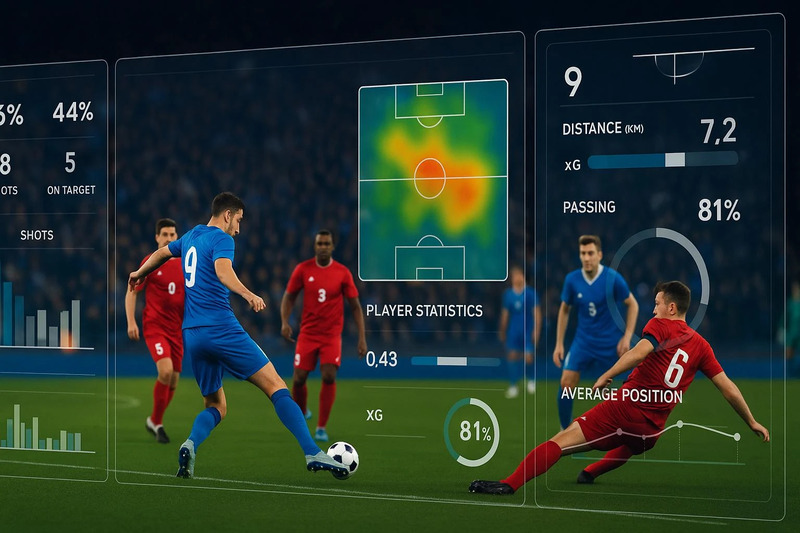
If you spend enough time around football, you realise quickly that everyone sees the game a little differently.
Two people can watch the same match and come away with completely different conclusions. One will say a team dominated, the other will say they were lucky. One focuses on possession, the other on chances. One remembers the goals, the other remembers everything that led up to them.
And the truth is, they’re usually both right — just from different angles.
That’s always been part of football. It’s what makes it interesting, but it’s also what makes it hard to pin down. Because for years, most analysis has been built on interpretation rather than structure.
That’s starting to change.
The game is producing more information than ever
Modern football generates a huge amount of data.
Every pass, every run, every defensive action — it’s all tracked. Not just in big matches, but across leagues, competitions, and levels. There’s more information available now than at any point in the game’s history.
But having data and understanding it are two completely different things.
Because on its own, data doesn’t tell you much.
You can look at numbers all day — possession, shots, passes — but without context, they don’t explain how a game actually unfolded. They don’t tell you why one team looked comfortable and another didn’t, or why certain situations kept appearing again and again.
That’s where the real challenge begins.
Turning numbers into something that makes sense
The difficult part isn’t collecting information.
It’s making sense of it.
You need to understand how different pieces of data connect. How one pattern leads to another. How a team’s style affects the type of chances they create or concede.
And most importantly, you need to see how those things repeat over time.
Because football is not defined by single events.
It’s defined by behaviour.
Why one match is never enough
Every fan has seen games that feel misleading.
A team wins comfortably without playing particularly well. Another loses despite doing most things right. You leave the match with a feeling that doesn’t quite match the result.
That happens because football allows for those moments.
Over 90 minutes, anything can happen.
But when you look at multiple matches, those one-off situations become less important. What matters more is what keeps showing up — the patterns that don’t change from game to game.
That’s where proper analysis begins.
The shift from reaction to understanding
For a long time, football analysis has been reactive.
A match happens, and then it’s explained afterwards. Pundits break it down, fans discuss it, and everyone builds a narrative around what they’ve seen.
But that approach has its limits.
It focuses on outcomes more than processes. It explains what happened, but not always why it keeps happening.
AI changes that slightly.
It moves the focus away from isolated events and towards repeated behaviour. It looks at how matches develop over time, not just how they finish.
Seeing connections that aren’t obvious
One of the biggest advantages of this approach is the ability to connect things that don’t immediately stand out.
For example, a team might concede goals in different ways, but when you look closer, you realise they all start from similar situations. A certain type of build-up, a repeated positional issue, a pattern that isn’t obvious when you only watch one match at a time.
Those connections are easy to miss.
But once you see them, they change how you understand the team.
Why this is where platforms like NerdyTips stand out
This is exactly the space where NerdyTips operates, and why it feels different from traditional football coverage.
It’s not about highlighting what happened in a single match.
It’s about identifying what keeps happening across many matches and turning that into something fans can actually understand.
Instead of reacting to results, it builds a picture based on patterns — how teams perform, how they create chances, how they handle pressure.
And that’s much closer to how football actually works over time.
It’s not about predicting one result
There’s a common assumption that AI in football is all about prediction.
Who will win, what the score will be, which team is better.
But that’s only a small part of it.
The real value is in understanding probability.
Not what will happen, but what is more likely to happen based on everything that has come before.
That’s a much more realistic way of looking at football.
Why probability makes more sense than certainty
Football doesn’t deal in certainty.
Even the best teams lose. Even the most consistent players make mistakes. One moment can change everything.
So instead of trying to be right all the time, AI focuses on being accurate over time.
If certain situations lead to similar outcomes often enough, that becomes useful information. Not because it guarantees anything, but because it helps you understand the game more clearly.
It brings balance to how teams are judged
One of the biggest issues in football discussions is how quickly opinions change.
A strong performance can suddenly make a team look unbeatable. A poor result can create doubt just as quickly.
AI doesn’t react like that.
It looks at longer periods, not just recent matches. It recognises trends rather than moments.
That doesn’t mean it ignores what just happened — it just places it in context.
And that context is what makes the difference.
It fits naturally with how football is evolving
At the top level, this way of analysing the game is already standard.
Clubs don’t rely on single matches to make decisions. They look at patterns, consistency, and long-term behaviour.
What’s changing now is that this level of insight is becoming more accessible to fans.
You don’t need to be inside a club to understand how a team plays over time. You can start to see it yourself, with the right tools.
It doesn’t replace the fan experience
There’s always a concern that bringing more data into football will take away from the enjoyment of the game.
But it doesn’t work like that.
You still watch matches the same way. You still react to goals, chances, and moments. That part stays exactly the same.
What changes is what comes after.
You have a clearer way of understanding what you’ve just seen.
It adds another layer to the game
Instead of replacing instinct, it adds to it.
You still have your opinions, your reactions, your way of watching football. But now you also have something that looks at the same game without emotion, without bias, just based on what actually happens over time.
Sometimes those two perspectives match.
Sometimes they don’t.
And when they don’t, that’s where things get interesting.
Why this matters for the future of football analysis
Football isn’t slowing down.
There are more matches, more competitions, more information than ever before. Keeping up with all of that using only traditional methods is becoming harder.
That’s why this kind of structured analysis is becoming more relevant.
Not because it replaces the human side of the game, but because it helps manage the scale of it.
The balance between data and the game itself
In the end, football will always be about moments.
A goal, a mistake, a decision — those are the things people remember.
But behind those moments, there are patterns that shape how games are played.
AI focuses on those patterns.
Fans focus on the moments.
And together, they create a fuller picture of what football really is.
Conclusion
The biggest change AI brings to football isn’t prediction.
It’s understanding.
It takes the huge amount of data the game now produces and turns it into something that reflects how football actually works over time — not perfectly, not completely, but clearly enough to make a difference.
And as more fans start to look at the game this way, platforms like NerdyTips are becoming part of that shift, helping turn raw information into something that finally makes sense when you step back and look at the bigger picture.